ACITC (A-SHI-TSH)
ACITC is a new project from The Great Harvest of Words that gives a voice to Anicinabek women.
ACITC
Kinakickotati8ak Angele Seguin acitc Veronique Rankin miiema kaotcimatcisek 2022. Misa mane kekon okimikotana8a. Mitac kaotcita8ak “Acitc”Nicopon kitacikikate kitcitep8eta8ak manima mane kinakickotatinani8ak kitci misosek, kitci minototatiak, kitci manatcitiak kita8it anicinapek8ek
ACITC was born from a set of meetings between Angèle Séguin and Véronique Rankin in 2022, and from their continuing exchanges with Anicinabek women. These discussions and reflections led to the creation of “ACITC,” which means “With” in the Anicinabemowin of Pikogan.
After more than two years of discussion, it became clear that this was an opportunity to develop a safe sharing space for women of the Anicinabe Nation.


Angèle Séguin
ACITC is rooted in a bond both fragile and enduring that I share with the Anicinabe Nation—on the one hand through my maternal lineage, and on the other through a medicine woman who once watched over my family’s health, at a time when we lived far from everything, including doctors.
Like so many others in Québec and across Canada, I grew up unaware that I carried within me the legacy of an Indigenous woman forced to leave her community for having married a white man. Unaware, too, of who this medicine woman was or where she came from. A story erased, silenced, passed down through absence rather than through words.
The story of my great-grandmother echoes that of countless Indigenous women shaped by the discrimination born of the Indian Act of 1876.
ACITC arises from a desire to draw closer to Anicinabek women: to listen attentively to what they have experienced, to what they wished they could have experienced, and to the paths traced by their dreams.
Through this collaboration, I seek to honor their resilience and to let their voices guide the creation. May our stories intertwine, nourishing a work that inspires in the days to come. Here, theatre becomes memory, transmission, and reconciliation—a fragile, living thread stretched between past and future.

Photo credit: Michelle Boulay

Philomène Brazeau
Angèle's great-grandmother
Véronique Rankin
I often think of my kitci mama, my grandmother.
Mother of eighteen children, she passed down to us a living legacy: her strength as a woman and her boundless capacity to love — both of which still live within us today.
My kitci mama carried, in silence, the pain of watching her children leave for residential school and return broken. That sorrow, I now carry in turn — like a memory that moves through generations, like a quiet wound that continues to bleed within me.
ACITC was born from the need to make her story heard, and the stories of so many other women of my Nation. I want to offer Anicinabek women a space to share their stories, to be heard, and to create together.
Our stories are different; our family paths are just as varied. And yet they meet. They are the stories of many Indigenous women who, across time, have lived in the shadows.
The shadow of society, the shadow of the Indian Act, the shadow of their husbands… the shadow. It is upon that shadow that I wish, today, to cast light.
My deepest wish: together, to kindle a bright light born of our stories — a light that will illuminate our voices, long kept in silence.

Photo credit: Elie Bédard
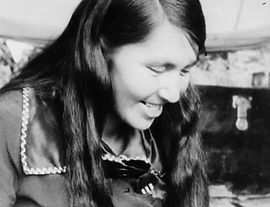
Emma
Véronique's grandmother
At the source of the creative act
Our Creative Process
We seek to gather the voices of Anicinabek women in order to create a work of theatre that brings their words and talents together in a collectively gestated creation. This work will take shape through an approach developed by Angèle Séguin, The Great Harvest of Words, an open and adaptable method that allows creations to emerge from lived experience and shared speech.
We envision this process as one of artistic and collective co-creation, shaped and continually refined through exchanges with the women of the Anicinabe Nation. Together, in a spirit of respect, attentive listening, and collaboration, we will give ourselves the freedom to make the necessary adjustments so that the process fully embraces their lives, culture, ways of thinking, and modes of expression.
It is in this spirit of exchange and co-creation that we move forward alongside essential partners. The Anicinabe cultural organization Minwashin welcomes us as artists in residence, nourishing the creation through the sharing of knowledge and support in community mobilization. Working with the Rouyn-Noranda Art Museum, we seek to foster dialogue, dissemination, and encounters with audiences exposed to our artistic work.
One principle remains fundamental for us: the creative process must allow for the emergence of free speech—uncensored and not shaped by predetermined questions. We aim to welcome the voices and visions of Anicinabekwek, which, gathered without alteration, will lead us to the finished work.
Artistic Collaborators
Discover the ACITC project’s artistic collaborators, their backgrounds, and their motivations.
Angèle Séguin and Véronique Rankin will welcome various contributors who will share their artistic talents and knowledge over the course of the project. This section will be updated as the project advances.
Paul Lefebvre, Dramaturgy Advisor
Why am I involved with ACITC?
First, there is my relationship with Indigenous peoples. First Nations people are better than anyone else at teaching us how to live on this land that we, as Eurodescendants, have invaded. I am involved with ACITC as a dramaturgical advisor, but first and foremost I am involved as a citizen: I am not guilty of the actions of my ancestors, even though I have benefited from the subjugation of the First Nations I become guilty if I contribute to perpetuating the effects of this subjugation through inaction. I have come to realize that, despite my good intentions, I am White and part of a history marked by colonization.
My job is to help playwrights tell their stories: it's my way of contributing to truth and reconciliation. I know that the Anicinabek have their own narrative codes that I don't fully understand. My role is to identify the diversity of ideas, experiences, and contradictions that emerge from the "My Words / Our Words", then organize them theatrically, while respecting human trajectories.
As is often the case at the beginning, the work remains mysterious: it is about learning to listen to what is said by the unsaid.
For me, it is also a question of continuing my rich artistic collaboration with Angèle Séguin, which began in 2015.

Photo credit: Ariane Laget
Matthew Gaines, Documentary Filmmaker and Director
Documentary filmmaker, director, and educator, I am one of Angèle Séguin’s long-time collaborators. Deeply moved by her 'théâtre citoyen' (citizen theater) approach and dedicated to working with Indigenous Nations since the beginning of my career, I devote my skills to exploring and highlighting the social issues that impact these communities.
I spent five years leading a major project with the "Centre d’Innovation Sociale en Agriculture" (CISA) at Cégep de Victoriaville, focusing on the establishment of community gardens in the Chisasibi, Opitciwan, and Manawan communities. In this role, I served as a video production mentor for youth in Manawan, specifically guiding a videographer through the filming and editing of video segments on agriculture and traditional harvesting.
Inspired by these successes, I hope my involvement in the ACITC project will lead to a true co-construction with the Anicinabe Nation, building bridges and fostering strong connections with the teams at Minwashin.

Photo credit: Fabienne Côté
Artistic Partners
The first steps of this artistic collaboration are already underway and will continue throughout the year, fostering an inspiring dialogue that highlights the experiences and perspectives of Anicinabe women.

The Circle of Women Knowledge Keepers
Angèle Séguin and Véronique Rankin develop this project alongside The Circle of Women Knowledge Keepers made up of Anicinabek women. Each woman—shaped by her deep connection to the land, her life journey, and her story—offers guidance and knowledge with care and generosity throughout the project, in a circular movement where voice, listening, and creation move forward together.
The Circle is rooted in an Anicinabe understanding of time, where nothing is linear or fixed. The gatherings of The Circle of Women Knowledge Keepers become moments of return and deepening, allowing words to flow freely, fostering a deeper understanding of the daily realities and challenges faced by Anicinabek women, and weaving a climate of trust that encourages open and heartfelt exchanges, where every voice finds its rightful place.
As our meetings unfold, the project will be enriched by the depth of their traditional knowledge and the strength of their memories. The hope is that their presence will nourish this creation and imbue it with meaning.
At every stage, Angèle Séguin and Véronique Rankin will advance alongside The Circle of Women Knowledge Keepers to share and affirm their intentions, refining the approach so that it faithfully reflects the words and stories of Anicinabek women. The voice of the Circle will guide the entire process, making this space a living circle—rooted in respect, listening, and co-creation.
In this way, the creative process unfolds as a collective space, where no voice is in isolation and each exists in relationship to the others. This circular exchange shapes the emerging work as an act of co-creation grounded in Anicinabe thought and practice.
A First Voice-Carrying Gathering
On March 10, the first bilingual online meeting of The Circle of Women Knowledge Keepers was held to introduce the ACITC project and begin a collective reflection on the role this circle will play in the project’s journey.
This theatrical creation project stems from a deep desire: to open a space where Anicinabek women can speak, share their stories, and break the silence. Through artistic creation, it seeks to bring forward stories that have too often remained unheard and to highlight the strength, resilience, and memory of Anicinabek women.
From the very first exchanges, the meeting became a rich moment of sharing and listening. Participants spoke about their life paths, their Anicinabe identity, and the realities that have shaped their experiences. Discussions brought forward stories related to education, challenges faced, and experiences of discrimination, but also to the strength and support of community.
As the testimonies unfolded, a shared conviction emerged: the stories of women must be heard and carried forward. Participants emphasized the importance of preserving and sharing their knowledge, memories, experiences, and dreams that shape the Anicinabe Nation and will nourish future generations.
No formal decisions were on the agenda. The essential purpose lay elsewhere: taking the time to meet, to recognize one another, and to open a space where stories can emerge in trust and safety. These first exchanges mark the beginning of a collective process grounded in listening, respect, and collaboration.
Participants also expressed strong enthusiasm for the upcoming first working residency. This stage will make it possible to validate tools and collaborative methods with Anicinabek women and to begin mapping out the next steps of the project together.
This first gathering marks the beginning of a shared path, where Anicinabek women can come together, tell their stories, and make their voices heard. Through this evolving creation, we seek to open a space for dialogue, understanding, and healing. We hope their voices will carry far beyond their own experiences — illuminating a more united and hopeful path for all women, regardless of their origins.
Visit our Calendar page to keep up with our events!
Members of the Circle of Women Knowledge Keepers

Marjolaine Étienne

Alice Jérôme

Louisa Papatie

Marilyn Chevrier

Jacqueline Michel

Roxanne Lauzon-Rankin

Tina Mapachee

Stéphanie Frost-Larivière
.jpg)
Yasmina Nail
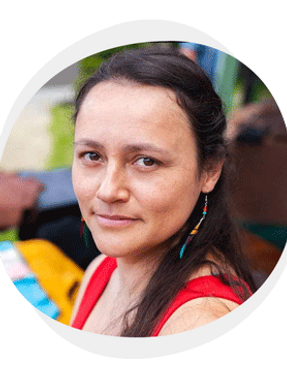
Eliane Kistabish

Caroline Lemire
ACITC An Evolving Work
ACITC An Evolving Work (2024 - 2029)
ACITC began in 2024 and will take place over several years. Much like the team’s logbook, it permits you to explore the milestones that have shaped the team’s journey so far—and those yet to come.
Listening to Women and the Territory (2024–2026)
First Reflective Residency (October 2024, La Bulle)
The first artistic reflective residency took place in October 2024 at La Bulle – Espace de création Artistique in Sherbrooke. Angèle Séguin, Véronique Rankin, Paul Lefebvre, and Matthew Gaines came together to build the initial work schedule.
Mindful of connecting with Anicinabe women across the region, the group agreed to open a dialogue with Roger Wilde, artistic advisor and multidisciplinary artist with the cultural organization Minwashin in Rouyn-Noranda. This initiative aimed to explore collaborative possibilities and foster meaningful, inclusive connections throughout the region.
The first exchanges to initiate collaboration with with Minwashin took place in Pikogan in November 2024, during a meeting attended by Roger Wilde and Véronique Rankin, which Angèle Séguin also joined. The partnership was then formalized in the winter of 2025 and expanded in the spring with the involvement of the Rouyn-Noranda Art Museum.
First Exchange Workshop with the Anishinabekwek (2025)
Prepared and facilitated by Véronique Rankin, Angèle Séguin, and Roxane Lauzon, with contributions from Caroline Lemire, Chantal Simard Nattaway, and Éliane Kistabish.
The first workshop with the Anicinabekwek, titled ICPENIMATANIK ANICINAPEK8EK / Honoring Anicinabekwek / Honorons les Anicinabekwek, took place on September 3, 2025, as part of the Miaja event organized by Minwashin at Timiskaming First Nation.
Creating a safe and supportive space was essential, allowing Anicinabek women to freely express their thoughts, impulses, and aspirations regarding the topics on which they wished to be heard.
This gathering also served to present the ACITC project transparently, share its intentions, and open a sincere dialogue about the forms it might take.
The first contours of the Circle of Women Knowledge Keepers began to take shape: a living, evolving space meant to accompany the project, rooted in the knowledge, experience, territory, and voices of the women who engage in it.
Three Exploratory Residencies (2025)
At the end of November 2025, Véronique Rankin, Angèle Séguin, Paul Lefebvre, Matthew Gaines, and Éliane Kistabish (Minwashin) carried out three exploratory residencies in Val-d’Or, Pikogan, and Timiskaming First Nation (Notre-Dame-du-Nord, Quebec).
These initial field initiatives allowed us to test our approach, to meet the women within their communities, to encourage them to speak out, and to welcome their shared interests in preparation for the next stages of the project. The exchanges proved to be rich and meaningful.
The residencies served both to confirm the relevance of our approach and to clarify the adjustments needed to more fully engage with the communities. They highlighted the importance of strengthening the project’s community grounding: a longer presence on the territory, greater visibility, the active involvement of a member of the Circle of Women Knowledge Keepers, and more thorough preparation upstream are now essential steps for moving forward.
The creative approach quickly established a climate of trust, opening a space conducive to speech and expression.
Research and Creation (2026-2027)
Through meetings, writing workshops, spaces for exchange, and the collection of testimonies, we aim to hear the voices of Anicinabekwek across all generations and communities. This approach is rooted in deep respect for knowledge, cultural rhythms, and the territorial realities of the Anicinabe, prioritizing attentive listening, long-term engagement, and quality relationships.
Psychosocial support is offered during meetings.
Production and Dissemination (2028-2029)
To date, no work been undertaken in this area. Production and dissemination will be carried out in close collaboration with our artistic partners.
Project Partners
Message from Caroline Lemire, Executive Director of Minwashin, Rouyn-Noranda

ACITC invites us to take part in an artistic process aimed at encouraging self-expression and fostering encounters with Anicinabek women. At Minwashin, we believe that art is a powerful means to support healing and strengthen a sense of pride within our communities.
This project offers a space for dialogue and creation that encourages the transmission of knowledge and the expression of Anicinabek women’s realities through theatre. ACITC also leads us to explore new paths and collaborate with new partners, opening enriching perspectives for our organization.
We see this as an opportunity to share knowledge, both artistic and cultural. That is why we support this initiative and recognize its value for the development of Anicinabe performing arts.
Minwashin is the organization gestating this project. Its role is primarily to support the artistic team in bringing the project to life by coordinating and by providing administrative and logistical assistance. Minwashin’s coordination will help bring the project’s participants together and connect with other initiatives.
Message from Jean-Jacques Lachapelle, Executive Director and Chief Curator of the Rouyn-Noranda Museum of Art

Located in Abitibi-Témiscamingue, the Rouyn-Noranda Museum of Art (MA) focuses on three area of research: local art, Indigenous Art, and Art of the Americas. A dialogue initiative began in 2015, creating opportunities for discussions between Indigenous and non Indigenous artists.
The Indigenous presence in our region is very visible and vibrant, yet there is still a great deal of ignorance surrounding Anicinabe culture. Therefore, the museum strives to be attentive to this ancient culture and to reflect it through exhibitions and events, in its art collection, and also within its board of directors, in its various activities, and even in the gift shop.
It is therefore with great interest that the Rouyn-Noranda Museum of Art is a partner in the ACITC project, which gives voice to Anicinabek women. As a promoter, we are firmly convinced that a broad audience will hear these voices. Many Indigenous and non Indigenous women—and even many men—will feel connected to these stories. In many ways, they will
make these words their own.
It is in this spirit that we wish to actively collaborate with the ACITC project.
Message from Marjolaine Étienne, President of Quebec Native Women

Quebec Native Women (QNW) considers it essential to support this initiative, which seeks to give voice to Anicinabek women through an artistic process of healing and the amplification of Indigenous women’s voices.
ACTIC addresses a fundamental need: to create spaces where Anicinabek women can share their knowledge and lived experiences and ensure the intergenerational transmission of their knowledge.
The proposed initiative, The Great Harvest of Words, is grounded in a respectful approach rooted in listening and co-creation. It will help strengthen cultural and community ties while fostering individual and collective healing through art.
I wish to acknowledge the creators’ strong commitment to conducting authentic and collaborative fieldwork with women of the Nation. The three exploratory residencies held in November 2025 attest to their intention to continue a sensitive approach deeply rooted in the community.
Financial Partners
The ACITC project is supported by various financial partners.